
Creating the Guilloche Console


I spend my New York winters studying design. Fifteen years ago, I saw an intriguing pattern in a book. It was “Historic Ornament,” by J Ward (1897). The pattern was this classic Greco-Roman guilloche motif, taken from a church in Venice, Italy.
I pasted the image on a bulletin board and subsconsciously viewed it over the years, while it brewed inside me.

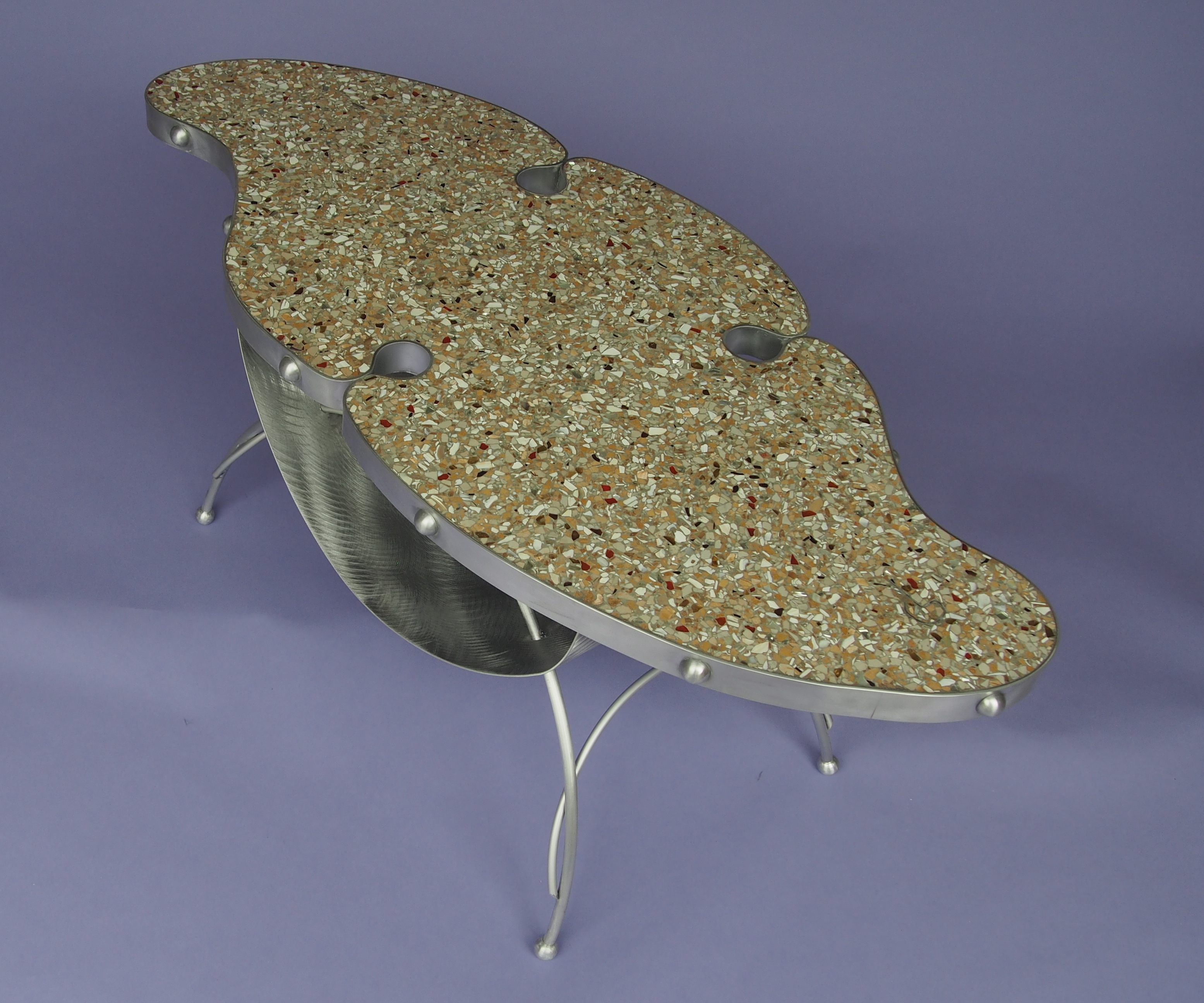
In Spring 2024, in preparation for the ICFF, I decided to create this Venetian pattern in Venetian terrazzo, as a console. What follows is a pictorial chronicle of the many steps in the design and fabrication of this dignified piece.
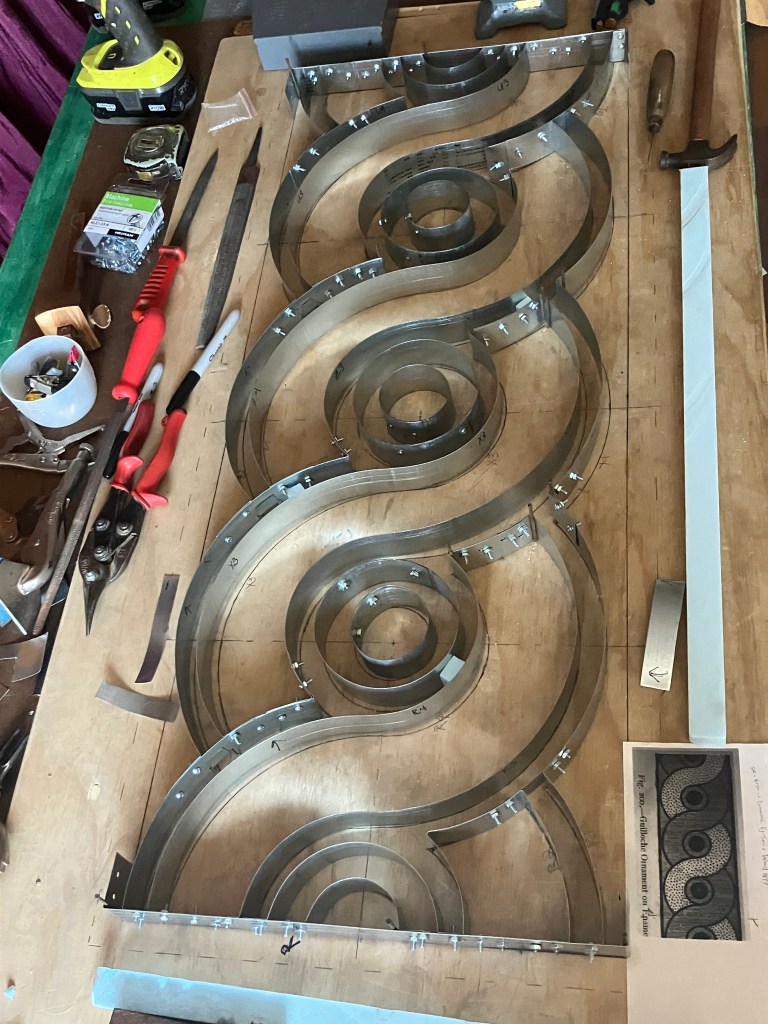
After laying out the full-scale pattern on paper, comes sheet metal fabrication, as seen here in my workshop (left).
Using 1-1/2 inch strips of galvanized sheet metal, I am forming circles using my slip roll. All elements will be cold connected using stove bolts and threaded rods. This mould is essentially a cookie cutter that will help me to “print” an image. Metal fabrication is one of the hidden skills within precast terrazzo.
The pattern can also be created in brass cloisonne’ strip, for embedding within the piece. The finished mould should conform to the drawing, of course.
Here is an image of the finished mould (right).

Next step is to think about the colors of the cement matrices and the marble varieties. Here are some color studies done to help with design decisions (left).
The color samples are done to lock in the mineral pigment recipes and to ensure good contrast between bordering fields of terrazzo.
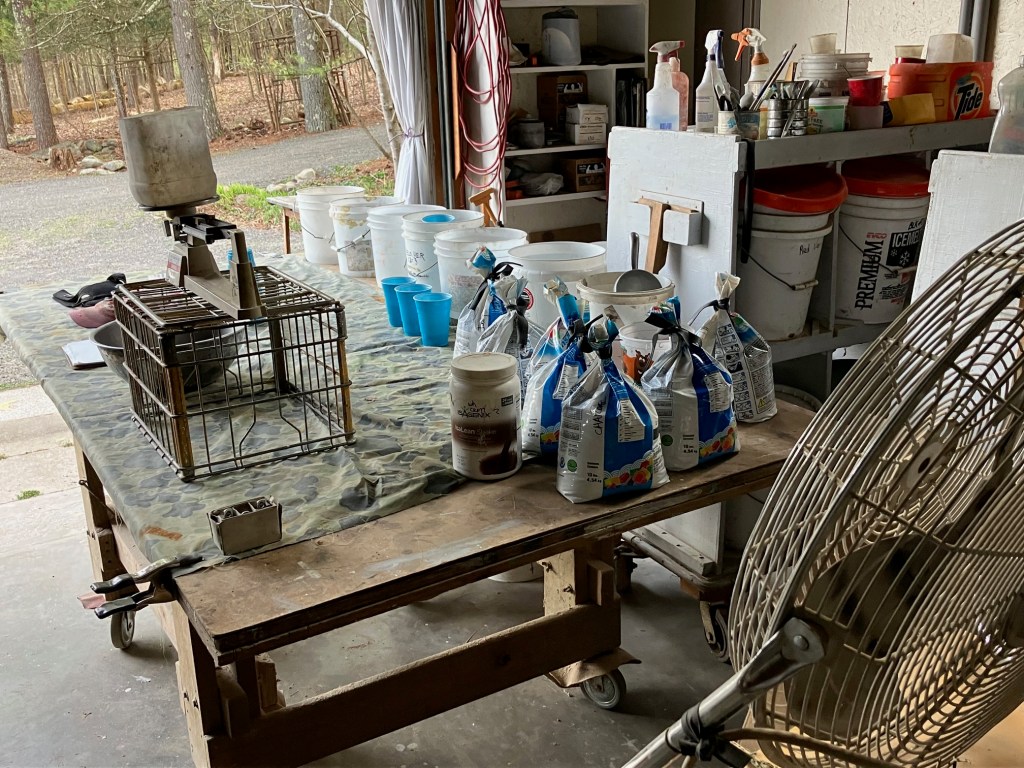
Creating cement colors is quite tedious. All pigments are naturally occurring minerals, and must be proportioned and weighed as dry powders along with the white or gray portland cements. All sample combinations are weighed and recorded dry on a triple-beam balance scale, measured to the gram. This is a dusty process.

The powders are forced through a fine brass sieve then mixed (left). This ensures a consistent color.
The samples are then cast. Twenty samples were cast for this (right).

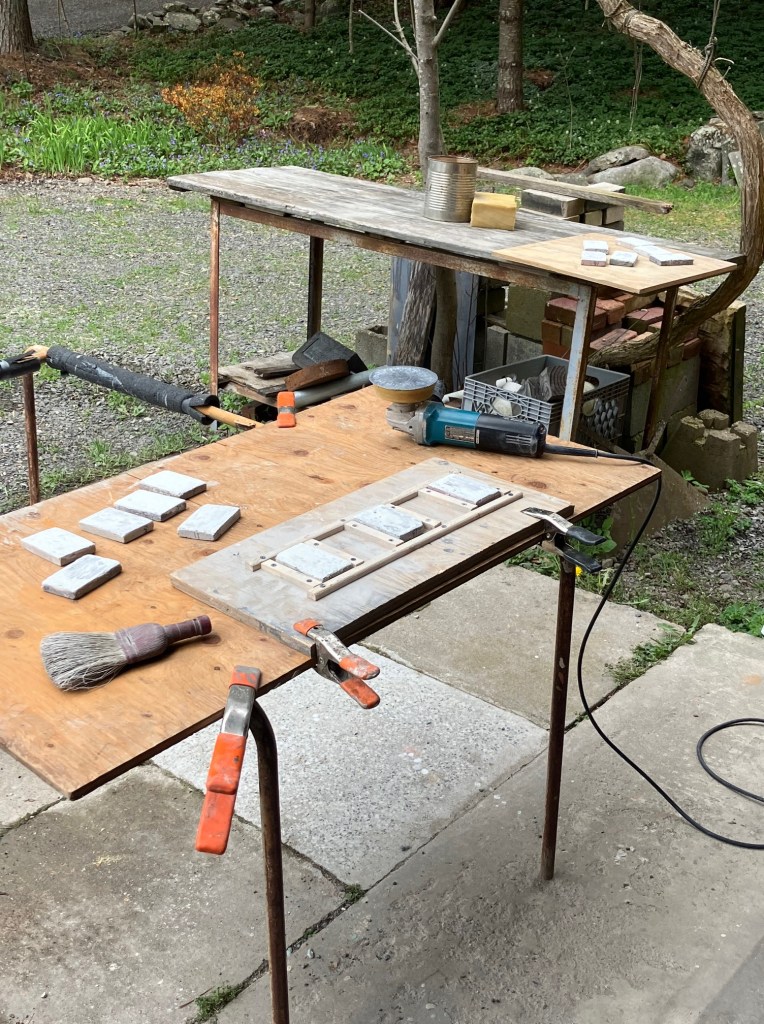
As with all terrazzo, the samples must be coarsely ground down, grouted with matching color cement matrix, then finely ground down to assess the actual color combinations.
This takes several days for each round of samples.

The samples are done and ready to be assessed (left).

After selecting final colors, the cement matrices are mixed according to sample recipes and put into sealed pails and are labeled.
Next step is to select and blend the sizes of the various colored marble aggregates. These are placed into pails as well.
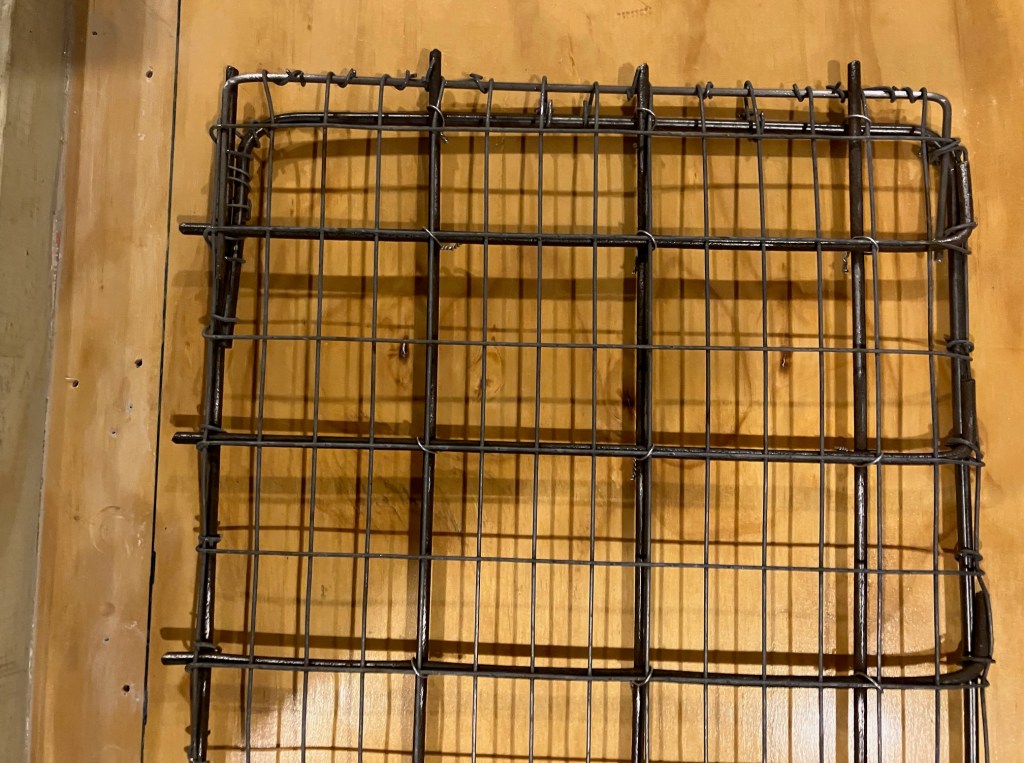
The steel reinforcement is next prepared.
Strength here is critical, as the terrazzo piece must be strong for one or several lifetimes of use, but especially to resist the extreme pressures of aggressive machine grinding.

Casting the Guilloche Console is now imminent. Masonry tools are laid out (left).
The Guilloche mould is made fast within the form (below).

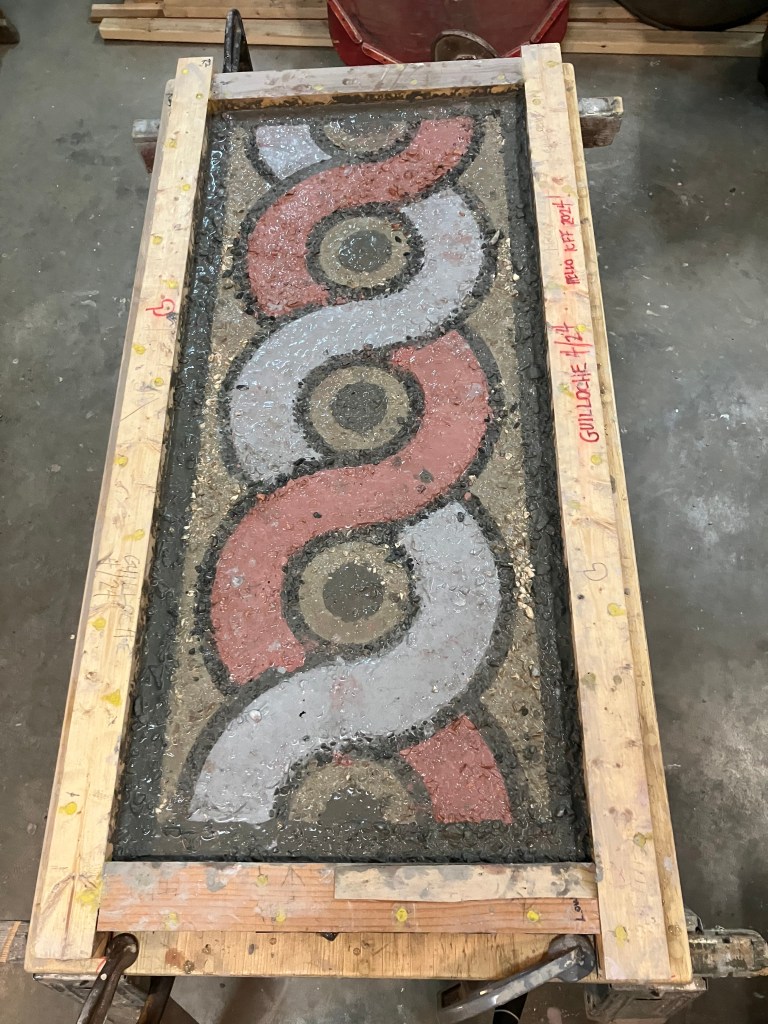
The various wet terrazzo mixes are placed and finally the mould is carefully removed, leaving this mosaic “print.” (left) The piece is damp cured for several days and then allowed to dry out completely over several more days.
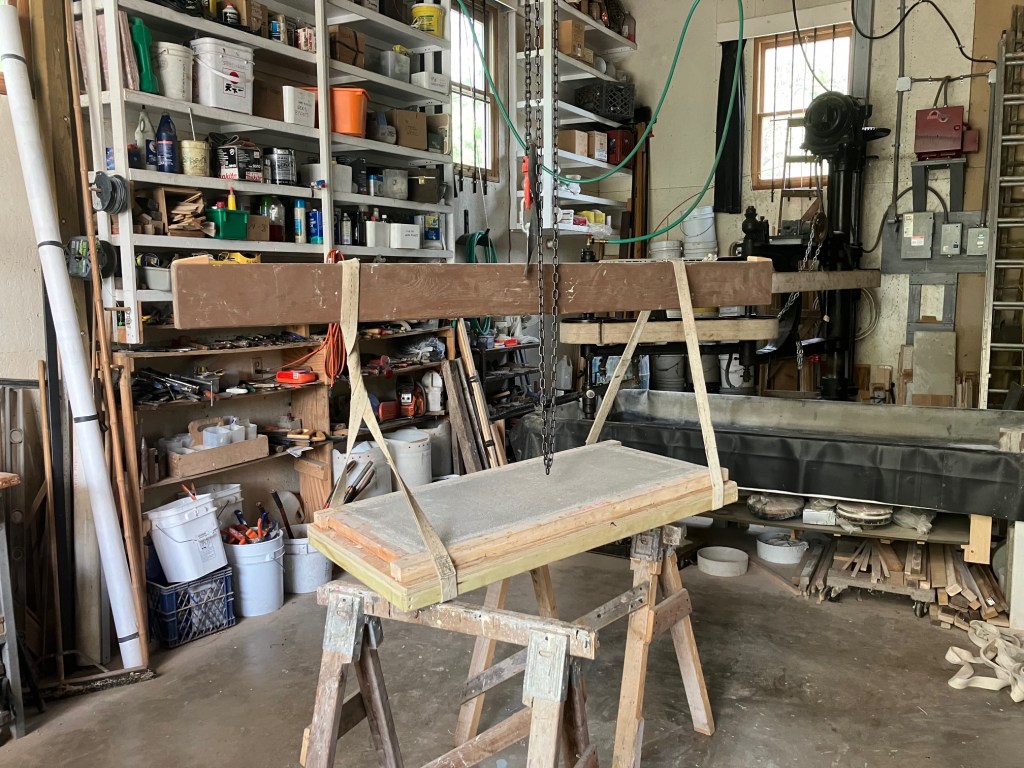
It is time to move the piece to our large, leather belt-driven overarm polisher that dates from 1913 (above).

First the back is ground flat (left). Next, the terrazzo face is thoroughly ground down (below).

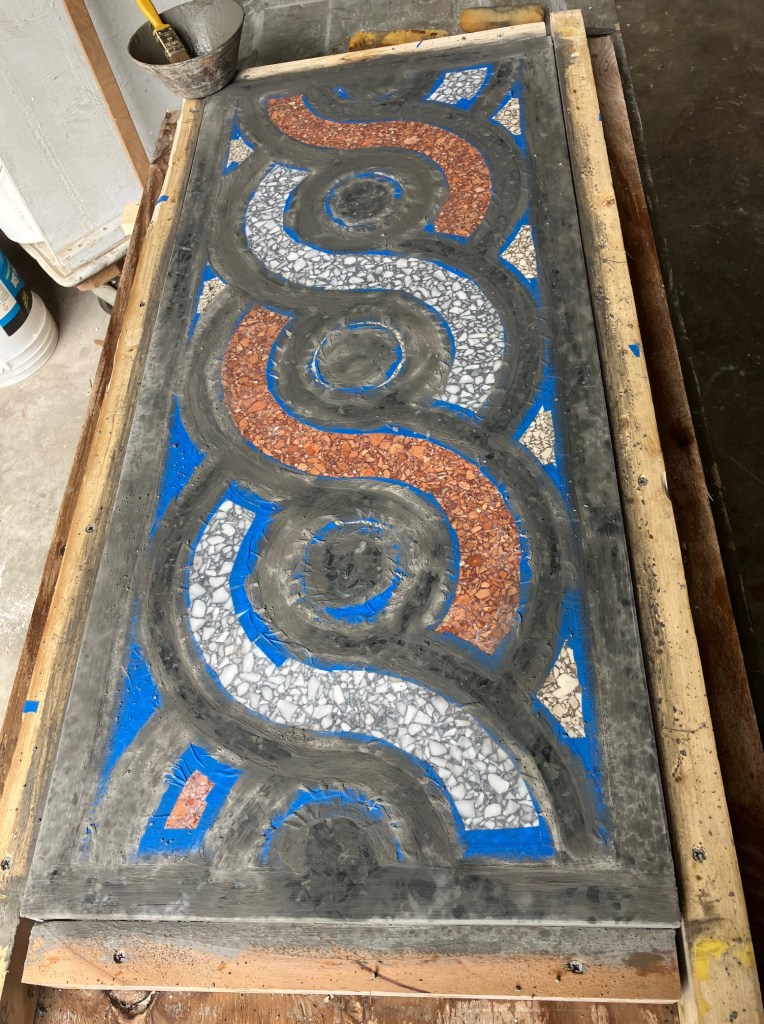
After rough grinding, all mosaic areas must be masked and grouted with corresponding colors (left).
Next day, the grout is ground off with a fine stone and the whole piece is then finely honed. The piece is lastly polished to a bright, reflective finish (right).
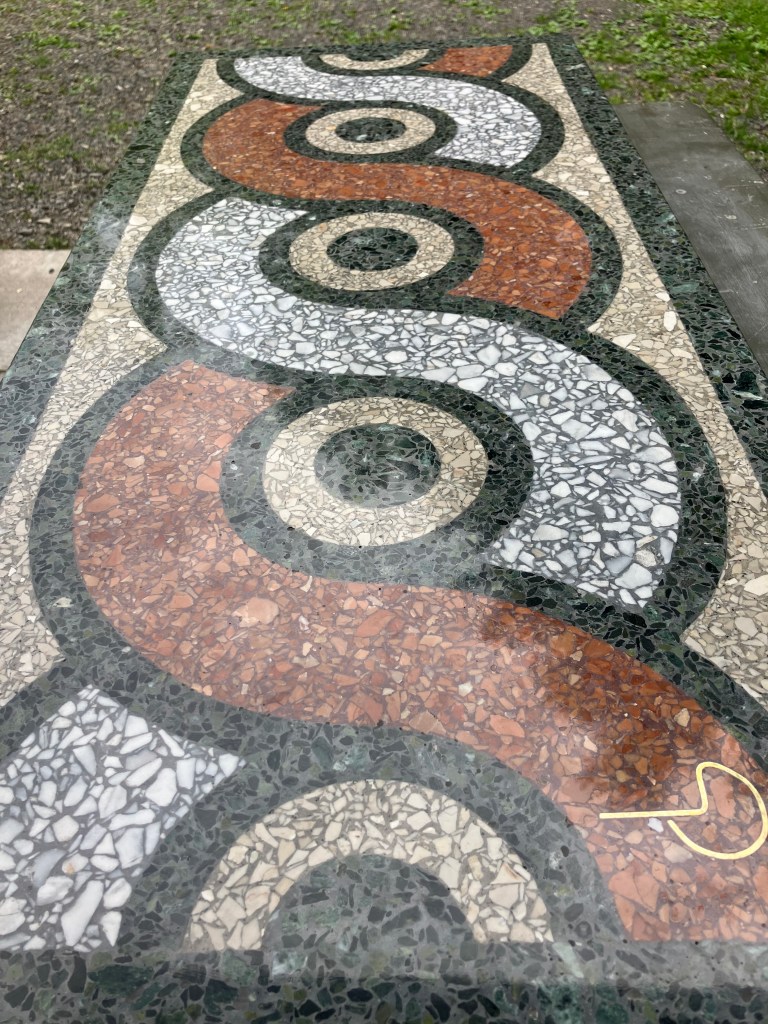
As the preceding reveals, there is a great deal of preparation and many steps involved in this work. The Guilloche Console is a highly designed and researched piece of art furniture, with strong Greco-Roman references. It is made from the classic natural mosaic materials of stone and cement, along with respectful assiduous craftsmanship.
The Guilloche Console was created in April 2024. It had its debut the very next month at the ICFF show at the Javits Center in New York City. Since our first appearance at the ICFF in 1990, this is our 18th exhibit at this show. It is the nation’s largest design trade fair, which began in 1989. This our 46th year of terrazzo artisanry.
South Beach Terrazzo and Architecture Tour
The following are highlights of my recent visit to the historic Art Deco district in Miami Beach, Florida, also known as South Beach. Photos are organized into two sections: Terrazzo and Architecture.
TERRAZZO
 Larios on the Beach (Ocean Drive). This dazzling terrazzo tile floor certainly caught my eye. It features an aggregate mix of crushed seashells, blue sea glass, and cross sections of spiraling nautilus seashells in a neutral gray matrix. If I were assigned to create these rectangular tiles, I would cast blocks of solid terrazzo with the above aggregate and matrix mix, and include whole spiral seashells in the mold. Later I would run a diamond saw blade through the block and slice off tile-thickness rectangular slabs. That’s how to get the cross sections. The highly designed interior is replete with polished, stunning terrazzo surfaces. I just had to inquire who owned this fabulous restaurant. The answer: The seven-time Grammy award-winning Gloria Estefan and her husband Emilio, who designed the space. (left)
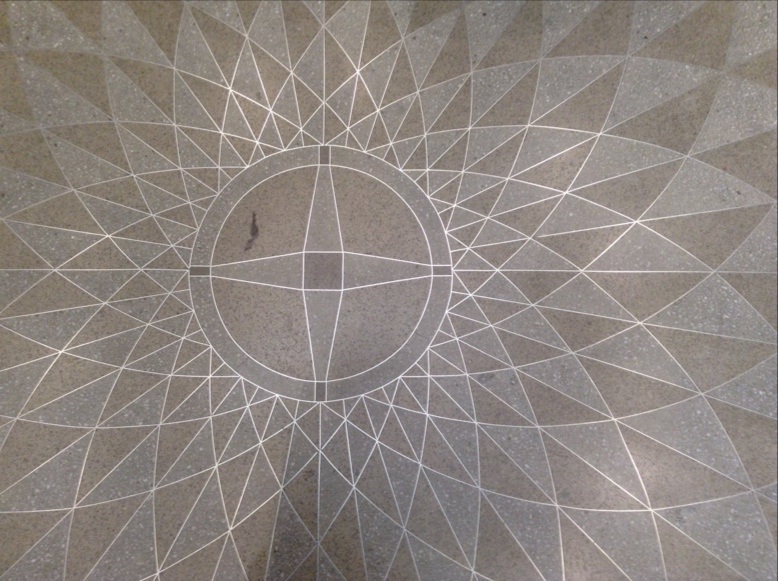
A richly patterned geometric terrazzo design in the former Chase Federal Savings & Loan Bank. Now a Banana Republic and very tastefully repurposed. I sense that this striking floor is probably a relatively recent installation. (right)

An exquisite geometric-patterned terrazzo hotel lobby floor in excellent condition with a bright polish. Wearing quite well… (left)
-

- Simplified compass rose on exterior porch with inlaid lettering
-
- Terrazzo lobby.
-
- Simple geometric overlay.
-

- Geometric overlay with inlaid lettering.
ARCHITECTURE

Marlin Hotel
The Marlin Hotel is a typical Miami Beach Art Deco gem. Smallish in size, it features a “Rule of Three” Deco façade with ornamental relief work depicting sub-aquatic marine life. The ornamental friezes are painted in “Tropical Deco” pastel colors. There is geometrically-patterned terrazzo flooring both in and outside. The corners of the building are rounded in “Streamline” style. Concrete “eyebrows” projected over windows provide shade. The perimeter of the façade is framed in blue neon lighting–very striking at night.

Better seen in the next image are the decorative steel railings featuring wave patterns and portholes or seafoam (your choice). Also note the use of native coral wall cladding and Deco wall sconces. (right)

This structure, awaiting renovation, shows a simple formula for elegance on what is basically an inexpensive flat white stucco façade. Two vertical pilasters connected by a decorative steel railing that sits on an “eyebrow”; a line of ornamental relief squares above the second story windows; and a scalloped cornice. One can of lime-proof pastel blue paint highlights all relief elements. Simple, elegant, and relatively inexpensive to create. (left)
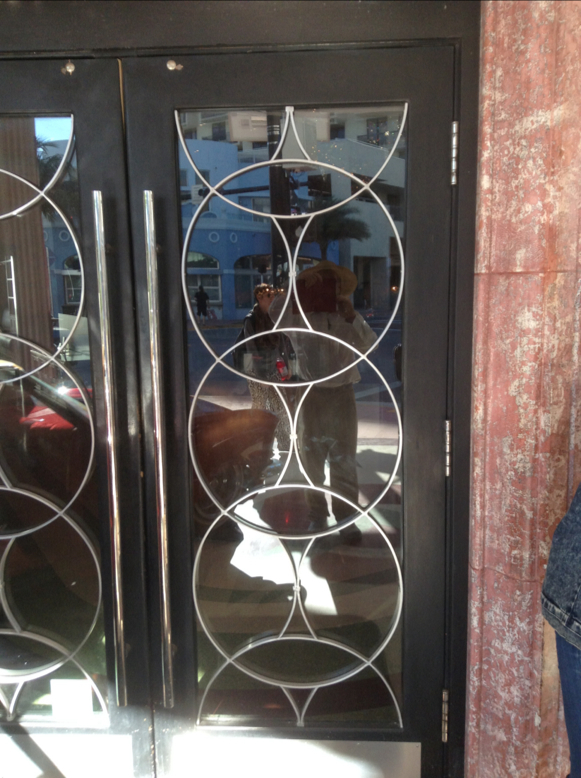
Door grille using geometric patterns (think portholes). Interior terrazzo floor visible through glass. That’s me taking this picture in the reflection. (left)
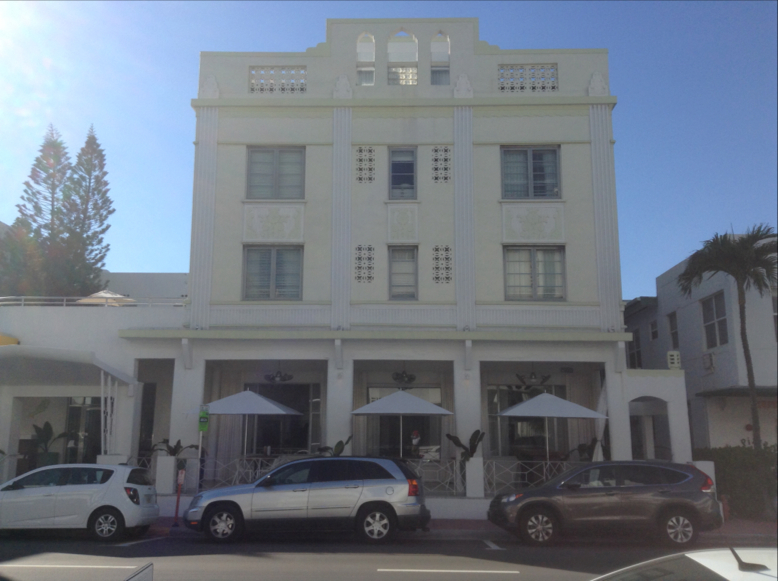
Note use of perforated decorative concrete block for ventilation in center, as well as truncated “campanile” style pediment that is reminiscent of the Alamo in San Antonio, Texas. (right)
-

- The Carlton Hotel.
-

- Another exquisite railing with nautical themes.
-

- “Wedding cake”

The vacant Greystone Hotel was recently sold for $7.5 million.
This recent visit was a delicious appetizer. I now have some questions that seek answers. Who were the artisans who installed these acres of colorful, decorative terrazzo? (We are kindred spirits.) Where did they come from? Italy? The Caribbean? (I myself, for example, learned to do terrazzo in Puerto Rico.) Was there some cross pollination between the Art Deco architecture in nearby Havana, Cuba and Miami Beach? This does seem apparent to me.
I will be exploring all this in the future. I look forward to my next visit to this exciting tropical locale.
 Terrazzo by Lorenzo