
Creating the Guilloche Console


I spend my New York winters studying design. Fifteen years ago, I saw an intriguing pattern in a book. It was “Historic Ornament,” by J Ward (1897). The pattern was this classic Greco-Roman guilloche motif, taken from a church in Venice, Italy.
I pasted the image on a bulletin board and subsconsciously viewed it over the years, while it brewed inside me.

In Spring 2024, in preparation for the ICFF, I decided to create this Venetian pattern in Venetian terrazzo, as a console. What follows is a pictorial chronicle of the many steps in the design and fabrication of this dignified piece.
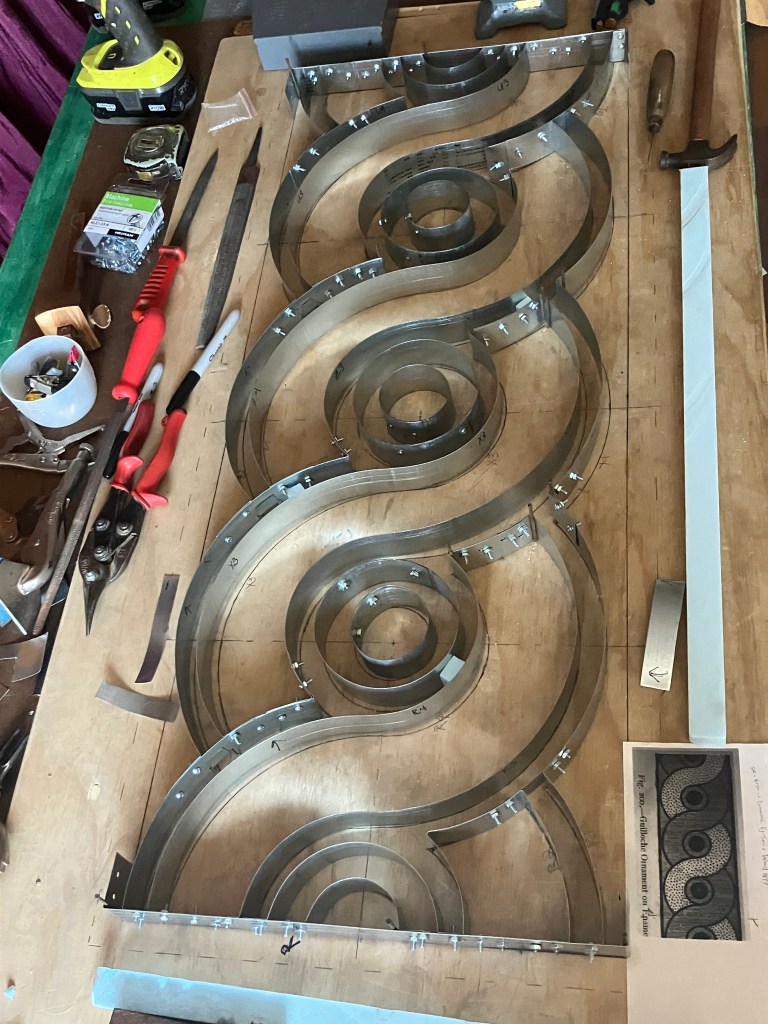
After laying out the full-scale pattern on paper, comes sheet metal fabrication, as seen here in my workshop (left).
Using 1-1/2 inch strips of galvanized sheet metal, I am forming circles using my slip roll. All elements will be cold connected using stove bolts and threaded rods. This mould is essentially a cookie cutter that will help me to “print” an image. Metal fabrication is one of the hidden skills within precast terrazzo.
The pattern can also be created in brass cloisonne’ strip, for embedding within the piece. The finished mould should conform to the drawing, of course.
Here is an image of the finished mould (right).

Next step is to think about the colors of the cement matrices and the marble varieties. Here are some color studies done to help with design decisions (left).
The color samples are done to lock in the mineral pigment recipes and to ensure good contrast between bordering fields of terrazzo.
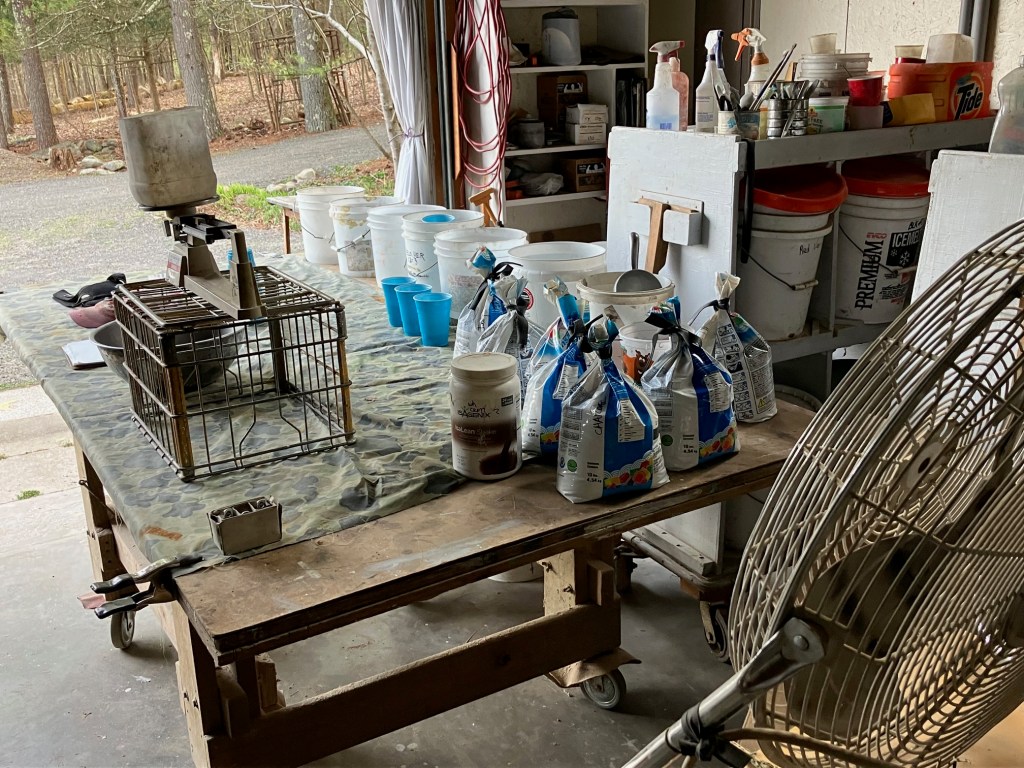
Creating cement colors is quite tedious. All pigments are naturally occurring minerals, and must be proportioned and weighed as dry powders along with the white or gray portland cements. All sample combinations are weighed and recorded dry on a triple-beam balance scale, measured to the gram. This is a dusty process.

The powders are forced through a fine brass sieve then mixed (left). This ensures a consistent color.
The samples are then cast. Twenty samples were cast for this (right).

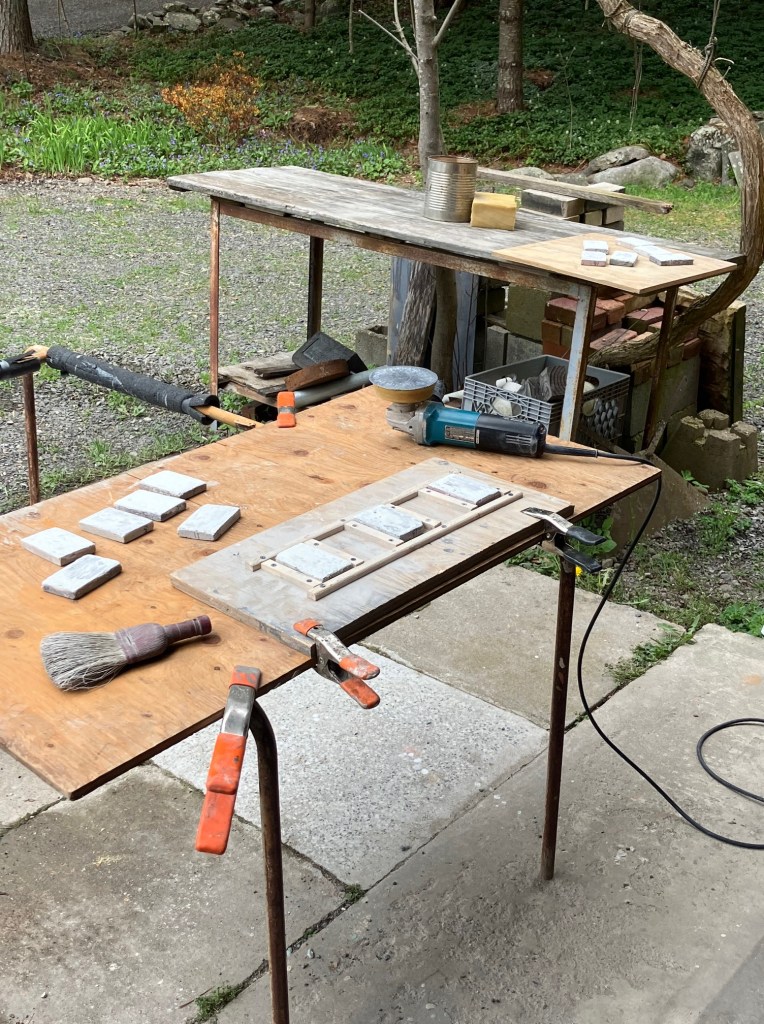
As with all terrazzo, the samples must be coarsely ground down, grouted with matching color cement matrix, then finely ground down to assess the actual color combinations.
This takes several days for each round of samples.

The samples are done and ready to be assessed (left).

After selecting final colors, the cement matrices are mixed according to sample recipes and put into sealed pails and are labeled.
Next step is to select and blend the sizes of the various colored marble aggregates. These are placed into pails as well.
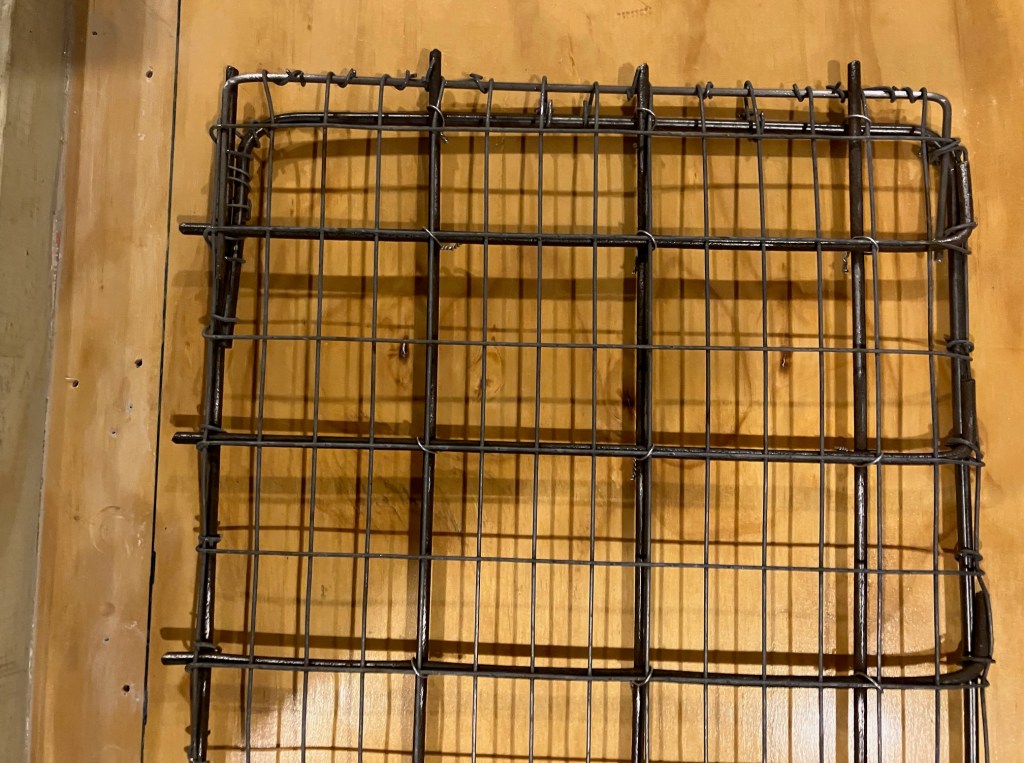
The steel reinforcement is next prepared.
Strength here is critical, as the terrazzo piece must be strong for one or several lifetimes of use, but especially to resist the extreme pressures of aggressive machine grinding.

Casting the Guilloche Console is now imminent. Masonry tools are laid out (left).
The Guilloche mould is made fast within the form (below).

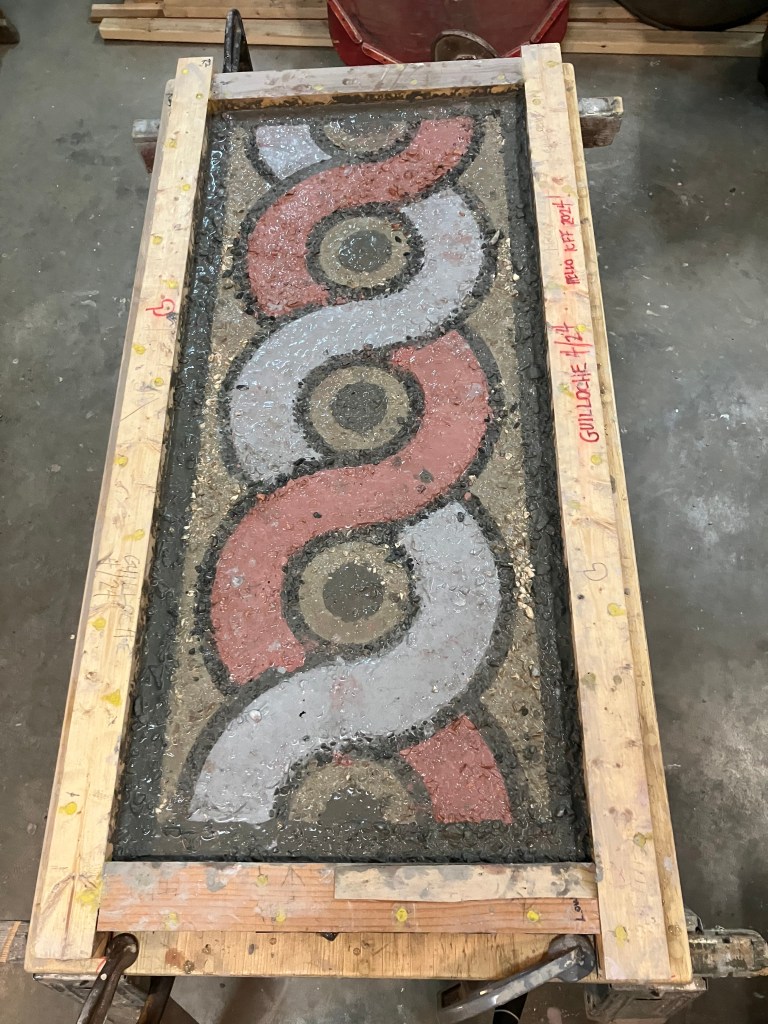
The various wet terrazzo mixes are placed and finally the mould is carefully removed, leaving this mosaic “print.” (left) The piece is damp cured for several days and then allowed to dry out completely over several more days.
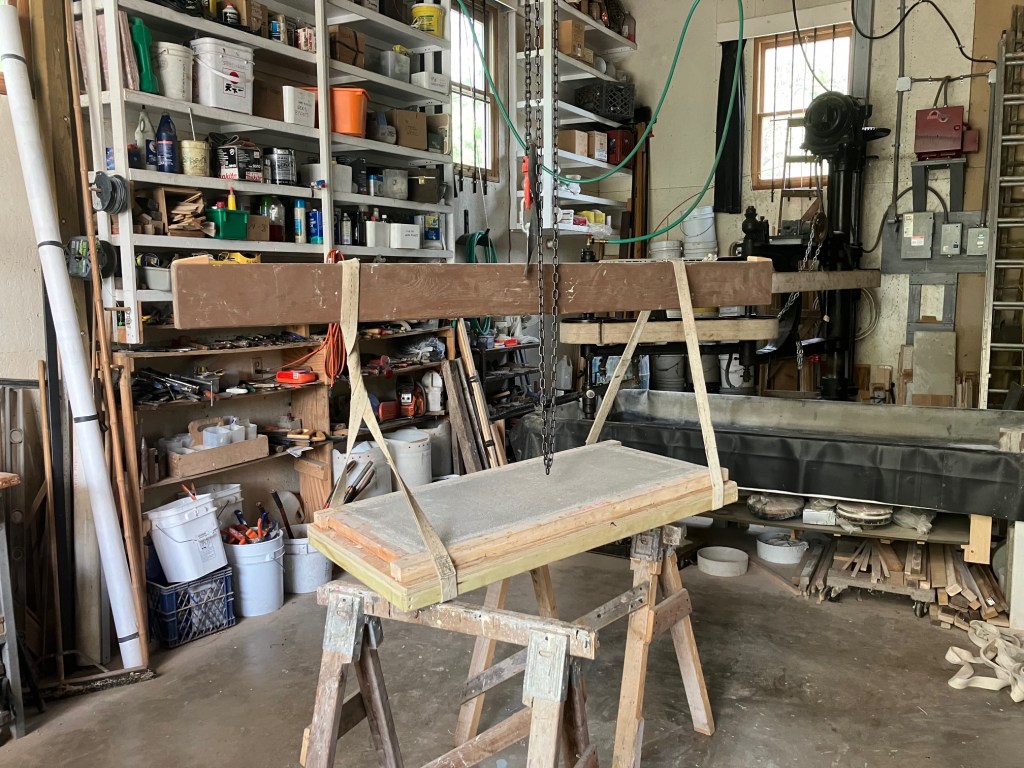
It is time to move the piece to our large, leather belt-driven overarm polisher that dates from 1913 (above).

First the back is ground flat (left). Next, the terrazzo face is thoroughly ground down (below).

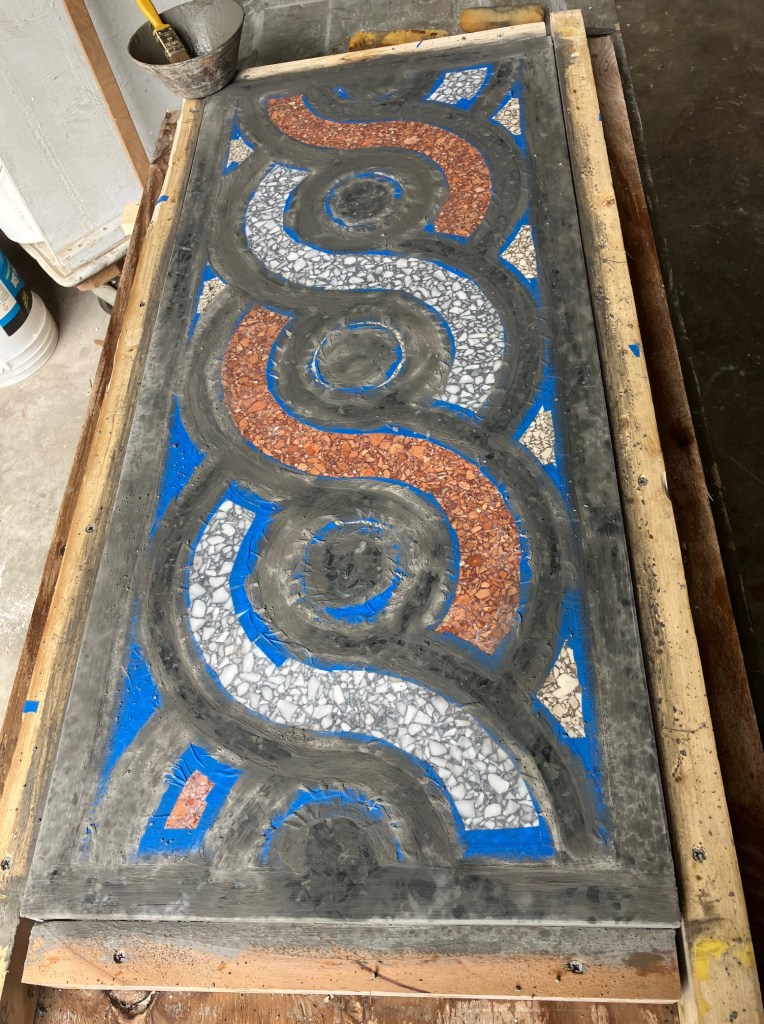
After rough grinding, all mosaic areas must be masked and grouted with corresponding colors (left).
Next day, the grout is ground off with a fine stone and the whole piece is then finely honed. The piece is lastly polished to a bright, reflective finish (right).
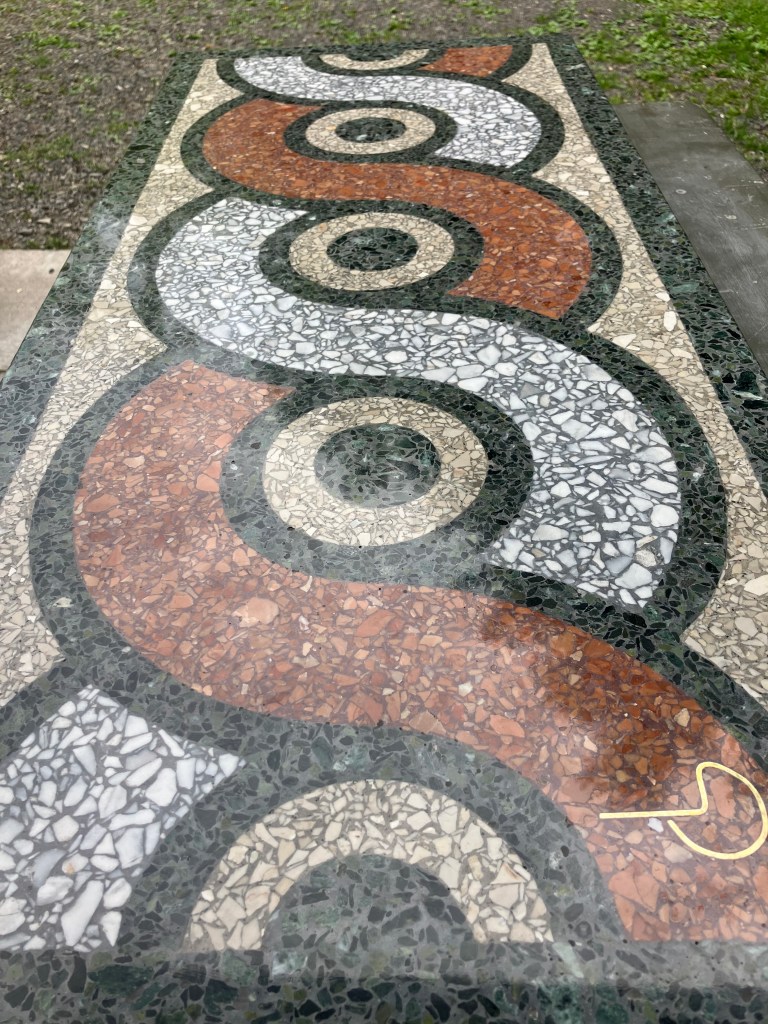
As the preceding reveals, there is a great deal of preparation and many steps involved in this work. The Guilloche Console is a highly designed and researched piece of art furniture, with strong Greco-Roman references. It is made from the classic natural mosaic materials of stone and cement, along with respectful assiduous craftsmanship.
The Guilloche Console was created in April 2024. It had its debut the very next month at the ICFF show at the Javits Center in New York City. Since our first appearance at the ICFF in 1990, this is our 18th exhibit at this show. It is the nation’s largest design trade fair, which began in 1989. This our 46th year of terrazzo artisanry.
On the Difference between Grinding and Polishing
 Caution: Portions of the following contain humor. If you have no sense of humor, discontinue reading now.
Well time has certainly passed since I started working with precast terrazzo. I could say that I had worked across five decades—which is true, since I started in 1979. But a more accurate accounting says this year is Number 33.
During this time, I have ground and polished more than my share of terrazzo. As with any basic process repeated endlessly over time, one comes to a deeper understanding of just what the heck one is doing. This is called insight (seeing the inner nature of the same old thing).
And so it goes with grinding and polishing, two critical steps that help distinguish precast terrazzo from its lately more popular first cousin, cast concrete; or more accurately, precast concrete.
The insightful difference between grinding and polishing, in essence, is this: grinding is scratching a surface; and polishing is melting it.
Here’s a simple experiment you can try at home to help make your understanding of grinding more, um, concrete. First, buy a shiny new car (I like Lamborghinis). Next, put a bit of beach sand on the hood. Place a smooth brick on the sand, and rub briefly in a circular motion. Remove brick and sand, and observe. You will notice score marks on the surface, and dust. The grits of sand, being harder than the paint, have scratched furrows into the surface. Behind the scratching action of the grits, plumes of dust have come out of those furrows. This is grinding at its most basic. You want to grind wet to remove the dust, expose new surface, and keep your grinding medium clean and sharp.
Polishing terrazzo is entirely different. You are ready to polish when you have ground with successively finer grits, say 400 or 500 grit, and no scores are visible. The terrazzo should be bone-dry for best results. You can buy polishing powder or mix your own by combining tin oxide, powdered oxalic acid and flake shellac made from the bodies of the Asian Lac Beetle. (Wear a respirator.) Change the grinding head to a polishing pad or “mop.” Put some powder on the surface and mist it with a spray bottle. Spread this mud evenly over the surface with the polisher, moving in small tight circles. As it begins to dry out, bear down strongly on the polishing head to create heat of friction. Move slowly. This heat and pressure will superficially “melt” the surface, creating a vitreous surface. Mother of pearl shell, when polished in terrazzo, will light up and become incandescent from the heat—truly a sight to behold.
Caution is indicated, as it is possible to overpolish and “burn” a surface. You then have to regrind and repeat all the steps once more.
To recap, once again, grinding is scratching, and polishing is melting—completely different processes. These can both be done by hand, but are extremely tedious. I did this handwork my first three seasons before I even knew that I was doing terrazzo, or that equipment existed.
Specialty Aggregates
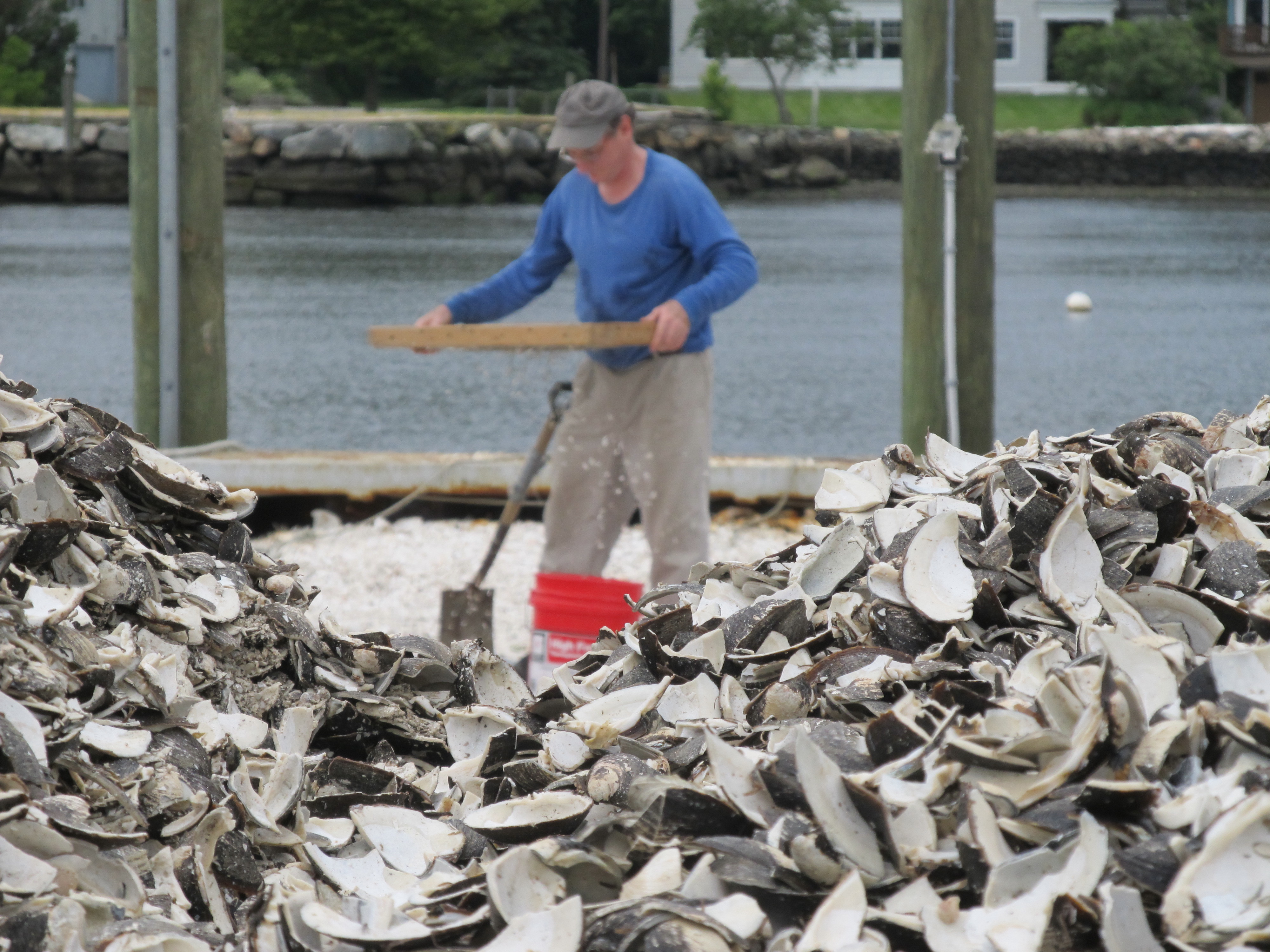
Specialty aggregates are great design elements, and they add a lot of pizzazz to the terrazzo.
I go to the coast of New England to source oyster shells, which I crush and grade myself. This is the recycled waste from the seafood industry. Oyster shells are wonderfully variegated, and take a nice polish.
Crushed mother of pearl shells have the same gorgeous iridescence as the pearls themselves. They are the recycled waste from the cultured pearl industry.
Aluminum and brass “chaff” are sourced from the waste stream of industries that mill these metals to make their products. They are small bits of metal that catch the light and add visual interest. Aluminum chaff really pops against a black background. Brass and aluminum letters are another specialty option. They create custom surfaces that speak.
I have pulled a lot of mirrors out of the trash. I crush and sift them. In terrazzo, mirrors create a dazzling effect, much like feldspar that occurs in granite.
Venetian terrazzo consist of oversized aggregates—so called because the palazzos in Venice used these large aggregates, to handsome effect, in their floors. More grinding is required in the process.
All manner of minerals, such as geodes and fossils, can be inlaid in terrazzo. You can find some great items at your local gem and mineral show, and it won’t break the bank. Glass aggregates are abundant and are another recycled ingredient. Use them with a translucent matrix, and you can create giant “lenses” of whatever colors you choose.
There are other options, but the trick is to choose aggregates of a similar hardness, so that it all grinds evenly.
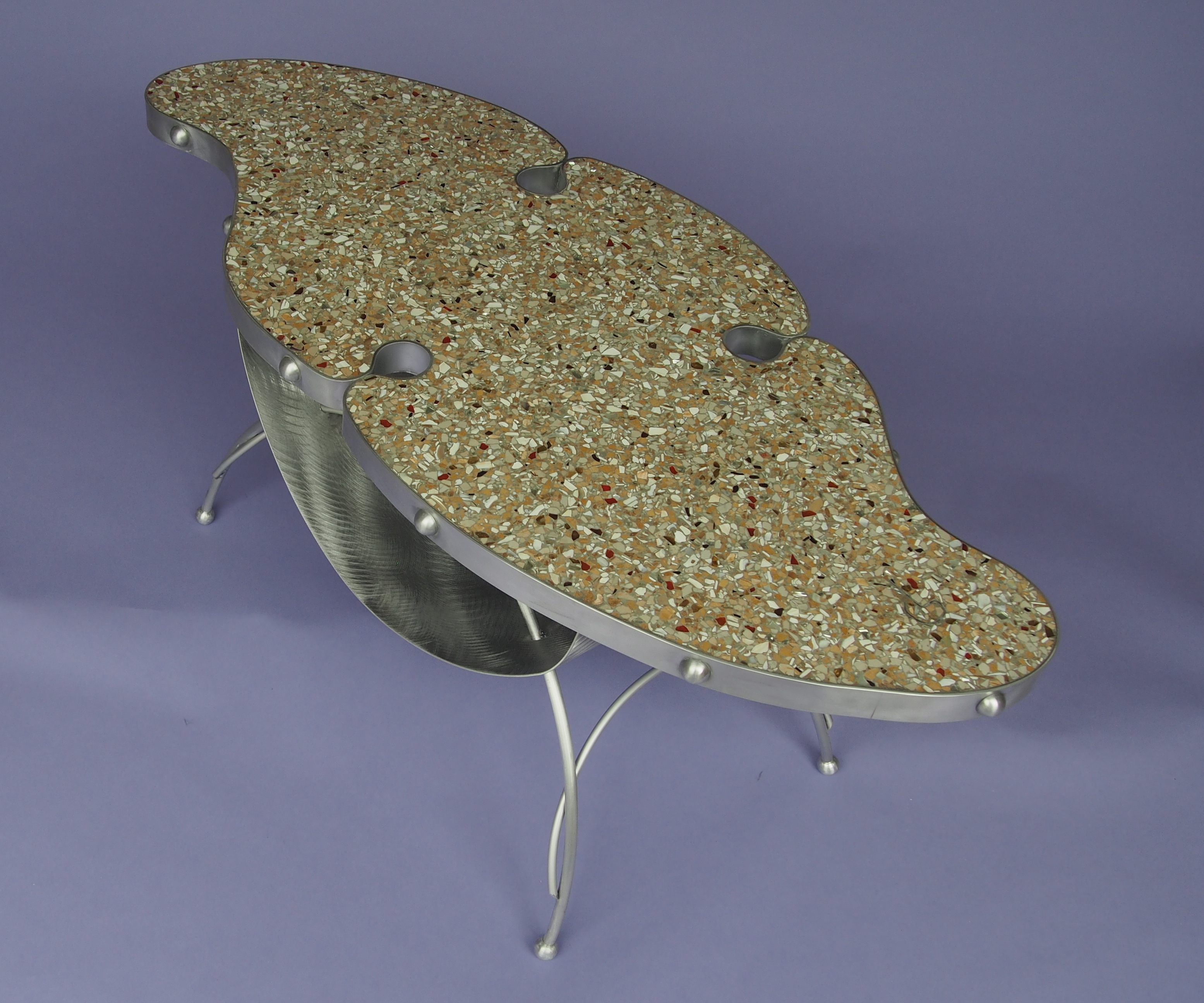
 Terrazzo by Lorenzo